








The world is facing major challenges. This affects every single one of us, us as a society, and us as a company. We are aware that online retail entails an increased carbon footprint. With every step and every bit of growth that is possible thanks to you as part of our amazing craft beer community, we also want to give something back. We have taken several measures to save as much CO2 as possible, offset our emissions , and even neutralize additional CO2 .
Shipping at Beer Belly Cologne is climate neutral! We are a partner of "Planet" and therefore automatically offset the CO2 emissions generated during the individual shipping of our packages.
But that's not all. For every order you place with Beer Belly Cologne, the Eden Reforestation Project plants a tree, and together we improve our carbon footprint. Learn more about the project here . Our Impact Report provides transparent updates on our progress.
We collect all our beers directly from regional breweries. Short and direct routes are good for the beer and the environment.
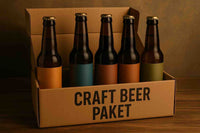
We also receive beer deliveries by mail. We reuse the cardboard boxes provided by the breweries to send you the beer. So don't be surprised if you receive a used, not new, box.
To save resources, especially for our shipping partners, we pack your order in the smallest possible packaging size.
Lager beer is also colloquially known as "lager." It is a bottom-fermented beer that matures through lagering. Examples of lager beers include Märzen and Pilsner. Historically, lager beer originated in 1841 in Kledering near Schwechat, Austria, thanks to a man named Anton Dreher, after whom it is still named today. Over time, machines were introduced to produce lager beer due to its immense popularity. The "Dreher" lager has survived all the different breweries that produce it today, particularly in Hungary and Northern Italy. However, the name "lager" has largely been replaced by the aforementioned beer names, Märzen and Pilsner. As a result, the term "lager" is used less frequently. Nevertheless, milder versions of lager exist, making it a popular choice among beer drinkers who find Pilsner too bitter and Export too old-fashioned.
The Pilsner beer style has come a long way. This beer and its derivatives dominate the world market, and we can assume that up to 80% of the beers consumed worldwide are based on this style. Driven by the spirit of the times and the desire for simple, uncomplicated thirst quenching, developments in the 20th century led to the emergence of American light beers, often referred to as "near water beers." Shortly before this, at the end of the 19th century, Pilsner inspired the Bavarians to "invent" Helles, today one of the most popular beers in the Free State of Bavaria.
The taste of Pilsner beer today is not entirely uniform. The range can vary considerably, from a balanced pale lager with a slightly more intense hop aroma (found in much of southern Germany) to a beer with a robust malt body and very grassy hop notes (in the Czech Republic), to a light, very pale pilsner with a strong hop bitterness, usually accompanied by subtle citrus notes (in northern Germany). Some breweries experiment with special aroma hops (single hop pilsner) or even produce an unfiltered version (Keller or Zwickel pilsner). In any case, you should be a hop enthusiast, then nothing will stand in the way of a journey through the world of pilsner beers.