The world is facing major challenges. This affects every single one of us, us as a society, and us as a company. We are aware that online retail entails an increased carbon footprint. With every step and every bit of growth that is possible thanks to you as part of our amazing craft beer community, we also want to give something back. We have taken several measures to save as much CO2 as possible, offset our emissions , and even neutralize additional CO2 .
Shipping at Beer Belly Cologne is climate neutral! We are a partner of "Planet" and therefore automatically offset the CO2 emissions generated during the individual shipping of our packages.
But that's not all. For every order you place with Beer Belly Cologne, the Eden Reforestation Project plants a tree, and together we improve our carbon footprint. Learn more about the project here . Our Impact Report provides transparent updates on our progress.
We collect all our beers directly from regional breweries. Short and direct routes are good for the beer and the environment.
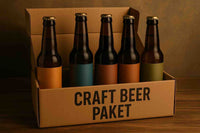
We also receive beer deliveries by mail. We reuse the cardboard boxes provided by the breweries to send you the beer. So don't be surprised if you receive a used, not new, box.
To save resources, especially for our shipping partners, we pack your order in the smallest possible packaging size.
"The history of modern Pale Ale – the younger (!) sister of India Pale Ale – is naturally rooted in the general history of English beer. Hops, the key ingredient for its aroma, spread across mainland Europe in the 8th century, but didn't reach the British Isles until the 15th century. This was due to immigrants from Holland who brought their brewing expertise to their new home. Kent became the first English hop-growing region, and hop merchants concentrated in the London borough of Southwark, where the Hop Exchange was also located. Incidentally, a particularly interesting microbrewery, Bishop, which produces very hoppy beers, can be found there today."
So how is a Pale Ale defined in terms of its sensory characteristics? Unlike Bitters and IPAs, the original gravity of a Pale Ale is between 11 and 14%, resulting in an alcohol content of 4.5-5.5%. The bitterness units (IBUs) range from 30 to 50, and the color varies around a light brown hue. The dominant flavor is hops, whose aromas are typically intensified through dry hopping. This gives Pale Ales robust fruit, grass, or herbal aromas, depending on the hop blend used, and always a strong, lingering bitterness. In any case, a Pale Ale is always an experience!