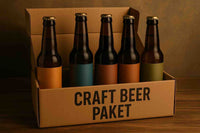
The world is facing major challenges. This affects every single one of us, us as a society, and us as a company. We are aware that online retail entails an increased carbon footprint. With every step and every bit of growth that is possible thanks to you as part of our amazing craft beer community, we also want to give something back. We have taken several measures to save as much CO2 as possible, offset our emissions , and even neutralize additional CO2 .
Shipping at Beer Belly Cologne is climate neutral! We are a partner of "Planet" and therefore automatically offset the CO2 emissions generated during the individual shipping of our packages.
But that's not all. For every order you place with Beer Belly Cologne, the Eden Reforestation Project plants a tree, and together we improve our carbon footprint. Learn more about the project here . Our Impact Report provides transparent updates on our progress.
We collect all our beers directly from regional breweries. Short and direct routes are good for the beer and the environment.
We also receive beer deliveries by mail. We reuse the cardboard boxes provided by the breweries to send you the beer. So don't be surprised if you receive a used, not new, box.
To save resources, especially for our shipping partners, we pack your order in the smallest possible packaging size.
"Porter and stout are top-fermented beers, which is why they belong to the ales family. Both styles use roasted malts, and often also smoked malts, as in smoked beers."
The Porter beer style was developed in the 18th century and originated in England. During the Industrial Revolution, people with physically demanding jobs needed a quick energy boost – and thus, Porter was born. The name "Porter" means "porter," highlighting the beer's roots. Porter ranges in color from dark brown to black and is characterized by caramel and sweet flavor notes. It has an alcohol content of approximately 4.5-6.3% and a low carbonation level (low effervescence).
The stout beer style (from the English word meaning "strong") originated from the porter beer style in the 19th century. The two styles are very closely related. A stout's color ranges from black to jet black, and it has an alcohol content of 7-12%. Like porter, this strong beer has caramel and sweet aromas. From the original stout, further subcategories have developed, such as Irish stout, American stout, Imperial stout, Milk stout, Dry stout, Chocolate stout, Coffee stout, Oatmeal stout, etc. Braised roasts pair perfectly with a dark stout.
Stouts and porters are difficult to distinguish from one another these days. Both belong to the strong beer category. The most significant difference is this: the malt used in porters is malted grain (the grain is germinated, then the germination process is interrupted and the grain is dried), whereas stouts are brewed with unmalted grain (the grain is milled and used without germination). Hops play a rather minor role in both, as the malt, with its sweet, caramel notes, takes center stage.