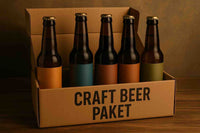
The world is facing major challenges. This affects every single one of us, us as a society, and us as a company. We are aware that online retail entails an increased carbon footprint. With every step and every bit of growth that is possible thanks to you as part of our amazing craft beer community, we also want to give something back. We have taken several measures to save as much CO2 as possible, offset our emissions , and even neutralize additional CO2 .
Shipping at Beer Belly Cologne is climate neutral! We are a partner of "Planet" and therefore automatically offset the CO2 emissions generated during the individual shipping of our packages.
But that's not all. For every order you place with Beer Belly Cologne, the Eden Reforestation Project plants a tree, and together we improve our carbon footprint. Learn more about the project here . Our Impact Report provides transparent updates on our progress.
We collect all our beers directly from regional breweries. Short and direct routes are good for the beer and the environment.
We also receive beer deliveries by mail. We reuse the cardboard boxes provided by the breweries to send you the beer. So don't be surprised if you receive a used, not new, box.
To save resources, especially for our shipping partners, we pack your order in the smallest possible packaging size.
"The Wiess or Wijss beers are the ancestors of Kölsch. But how did this beer style originate and what then led to Kölsch?"
The origins of Kölsch can be traced back to Keutebier, which we've already discussed and which enjoyed popularity from the Middle Ages through the Renaissance. From this Keutebier, Cologne's Wiess developed in the 19th century, derived from Wijss beer, or wheat beer. Yes, that's right, wheat beer comes from Cologne and was drunk there unfiltered. It got its white appearance from the wheat, and unlike today's Kölsch, it was rather milky and cloudy.
It tasted particularly raw and cloudy, which is why it had to be drunk very quickly. Because it was unfiltered, it didn't keep for long and the yeast quickly made it go flat. The shelf life of a Wiess could be extended to up to two weeks by aging it in barrels. It was even tapped from the brewing vats while the yeast was still present. The final transformation into Kölsch took place in 1918, shortly before the end of the First World War. Since 1985, this Cologne beer specialty has been protected as the only German beer innovation, and only about 24 breweries in and around Cologne are allowed to call their beer Kölsch.