The world is facing major challenges. This affects every single one of us, us as a society, and us as a company. We are aware that online retail entails an increased carbon footprint. With every step and every bit of growth that is possible thanks to you as part of our amazing craft beer community, we also want to give something back. We have taken several measures to save as much CO2 as possible, offset our emissions , and even neutralize additional CO2 .
Shipping at Beer Belly Cologne is climate neutral! We are a partner of "Planet" and therefore automatically offset the CO2 emissions generated during the individual shipping of our packages.
But that's not all. For every order you place with Beer Belly Cologne, the Eden Reforestation Project plants a tree, and together we improve our carbon footprint. Learn more about the project here . Our Impact Report provides transparent updates on our progress.
We collect all our beers directly from regional breweries. Short and direct routes are good for the beer and the environment.
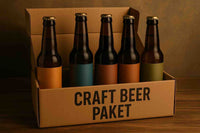
We also receive beer deliveries by mail. We reuse the cardboard boxes provided by the breweries to send you the beer. So don't be surprised if you receive a used, not new, box.
To save resources, especially for our shipping partners, we pack your order in the smallest possible packaging size.
Notre-Dame de Leffe was a monastery founded in 1152 by the Premonstratensians, that is, by abbey fathers who distinguished themselves through their special hospitality.
Pilgrims were always warmly welcomed in Leffe, and in 1240the abbey fathers decided to build a brewery to produce a healthy, fortifying beverage (diseases such as the plague ravaged the region at that time, and boiling the water during the production of the top-fermented Leffe beer killed all germs). After the French Revolution, the monastery was reopened in 1929. The abbey church was rebuilt on the old farmland, as the beautiful 18th-century church had been destroyed. Each abbey father had a specific role and was entirely dedicated to serving the community.
The Leffe Monastery at its height in 1740: In the foreground is the mill with its timber-framed gable, powered by the waters of the Leffe River. In the background, two rival fortresses face each other: the tower of Montorgueil and the Château de Crévecoeur. An untrained brewmaster worked for the monastery and created a Leffe beer so delicious that the parishioners preferred to drink a Leffe on Sundays rather than go to church. The abbot had to take firm action.
The monastery and brewery wereclosed during the French Revolution and seemed to be nothing more than a distant memory until the monastery reopened in 1929. In 1952, Abbot Nys and Albert Lootvoet decided to revive Leffe's brewing tradition with its closely guarded recipe and produce several delicious Leffe beers. Now, AB InBev has taken the reins and is committed to the Leffe beer tradition, which dates back to 1240.