






The world is facing major challenges. This affects every single one of us, us as a society, and us as a company. We are aware that online retail entails an increased carbon footprint. With every step and every bit of growth that is possible thanks to you as part of our amazing craft beer community, we also want to give something back. We have taken several measures to save as much CO2 as possible, offset our emissions , and even neutralize additional CO2 .
Shipping at Beer Belly Cologne is climate neutral! We are a partner of "Planet" and therefore automatically offset the CO2 emissions generated during the individual shipping of our packages.
But that's not all. For every order you place with Beer Belly Cologne, the Eden Reforestation Project plants a tree, and together we improve our carbon footprint. Learn more about the project here . Our Impact Report provides transparent updates on our progress.
We collect all our beers directly from regional breweries. Short and direct routes are good for the beer and the environment.
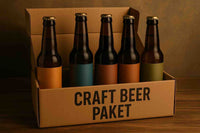
We also receive beer deliveries by mail. We reuse the cardboard boxes provided by the breweries to send you the beer. So don't be surprised if you receive a used, not new, box.
To save resources, especially for our shipping partners, we pack your order in the smallest possible packaging size.
"Our beer is down-to-earth, sustainably brewed and above all delicious!"
It all started in Cologne's Südstadt district. A group of friends and I began brewing our own beer at home, using a beginner's brewing kit. Well, the first beer wasn't exactly delicious—slightly sour and way too carbonated. But we drank it with pride. You can probably guess how things progressed from there. The beers improved, and so did the equipment. There's this one LEGO Duplo brick that was, for a long time, the centerpiece of our first homemade lauter tun. It always had to be placed in a specific position under the tap of the tun for the lautering process to work properly. That's how it all began. And in a place steeped in history. The Balchem brothers ran a brewery here in the cellars of the Kat18 complex until World War II. Beer was served in the Balchem house on Severinstraße.
The entire residential complex at Kartäuserwall 18, with its underground former brewery rooms, was occupied by the left-wing scene in 1980 and is still the scene of a very special community of artists, small business owners, individualists, the association Kat18 eVua.
We've finally managed to move from our apartment kitchens into a small but perfectly formed brewery. At last, we have space in the cellar again. No more bubbling fermentation tanks cluttering up our apartments. Unfortunately, our original plan to secure part of the old Balchem brewery premises for our venture hasn't yet materialized. These spaces are currently hotly contested and a real political issue. You can certainly find articles about it in the press. As an alternative, we've now settled in Hürth with our small brewery. With love and dedication, we've been brewing our beers here in 68 square meters since January 2020, with a certain sense of independence and freedom. But the final chapter is far from over!
In order to be proud of our brewed beers, we must have a clear conscience about what we do.
But what exactly does that mean? For us, it's clear: we only use sustainably produced raw materials for our beers. This also includes sourcing as regionally as possible, meaning we don't use any aroma hops from overseas. The family-run business "Rhönmalz" in Lower Franconia supplies us with handcrafted malts. We also work with "Biohof Friedrich" from Franconian Switzerland, one of the few organic hop growers. Both suppliers provide us with the finest ingredients we need for our beer. It's important to us that we use raw materials whose characteristics reflect their original growing conditions—that is, ingredients that haven't been blended from different batches to achieve a higher quality. We want to be close to the producers and see the differences in the raw materials. This is authentic, unadulterated, and original . Therefore, every batch of our beer has its own unique character.
And since we manage our brewing processes almost entirely without automation, a certain degree of variation in our beers is not only a consequence but also intentional. Bottle conditioning is also part of our craft brewing methods. This involves a small secondary fermentation in the bottle, which naturally produces carbon dioxide. This means that all our beers are more or less naturally cloudy.
Besides plenty of peace and quiet and patience, these are all things that define artisanal brewing, and you can see that reflected in our beers. Of course, nobody's born a master, but we have the ambition and look forward to continuously improving and brewing beers that are down-to-earth, yet also unusual and delicious. And on the side, we also feed the cows from the neighboring dairy farm, because they love our spent grain…"